Introduction
A few years ago, if someone had told me that I could build lean muscle without stepping inside a gym, I probably would have laughed. Like many people, I believed expensive gym memberships, fancy machines, and heavy barbells were the only way to get stronger. But life got busy, my schedule became unpredictable, and I simply could not make time for the gym.
Instead of giving up on my fitness goals, I decided to work with what I had. I started exercising at home, in my backyard, and even in small spaces where I barely had enough room to stretch. Surprisingly, I noticed real changes. My body became stronger, my muscles looked more defined, and I felt healthier than ever.
The biggest lesson I learned was that building lean muscle is not about where you train. It is about how consistently you challenge your body, how well you eat, and how much recovery you allow yourself. If you have been waiting for the perfect time to join a gym before getting started, let me tell you that you already have everything you need.
In this article, I will share the methods that helped me build lean muscle naturally without expensive equipment or a fitness center.
What Lean Muscle Really Means
Before I started my journey, I thought bigger muscles automatically meant stronger muscles. After learning more about fitness, I realized lean muscle is different.
Lean muscle simply means having strong, defined muscles with relatively low body fat. Instead of focusing on becoming bulky, I wanted a balanced body that looked athletic and moved well every day.
Building lean muscle improves strength, posture, metabolism, and overall health. It also helps burn more calories throughout the day because muscle tissue requires more energy than fat.
Once I understood this, my goal shifted from simply lifting heavier weights to creating a healthier and stronger version of myself.
Your Body Weight Is More Powerful Than You Think
One mistake I made at the beginning was underestimating bodyweight exercises.
I assumed push ups and squats were only for beginners. After trying proper variations with good form, I quickly realized they can be extremely challenging.
Your own body provides enough resistance to stimulate muscle growth if you continue increasing the difficulty over time.
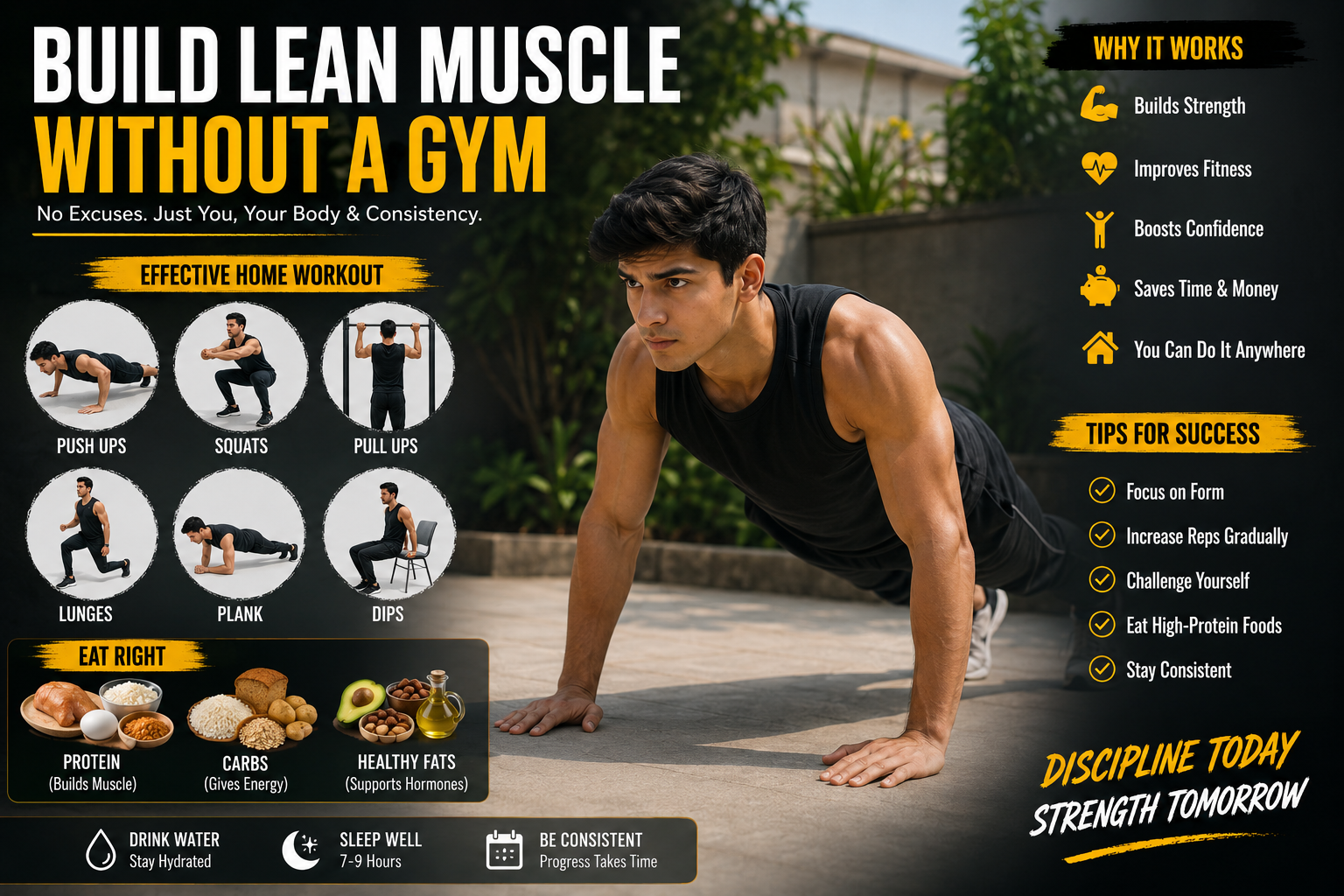
Some of my favorite bodyweight exercises include:
Push ups
Pull ups
Bodyweight squats
Walking lunges
Bulgarian split squats
Glute bridges
Pike push ups
Planks
Mountain climbers
Burpees
These simple movements work several muscle groups at once, making them incredibly effective.
Progressive Overload Still Matters
One thing I learned from experienced trainers is that muscles grow only when they are challenged.
Many people think progressive overload only applies to lifting heavier weights. That is not true.
Without a gym, I created progressive overload in different ways.
I increased the number of repetitions.
I performed more sets.
I slowed down each repetition.
I shortened my rest periods.
I switched to more difficult exercise variations.
I focused on perfect technique.
These small changes kept my muscles adapting every week.
Master the Basic Exercises First
I made the mistake of trying advanced exercises too early because they looked impressive on social media.
Instead, I went back and mastered the basics.
A perfect push up is much better than twenty sloppy ones.
A deep squat with proper form builds more muscle than rushing through dozens of repetitions.
Once I improved my technique, every workout became more effective.
Quality always beats quantity.
Train Every Major Muscle Group
One habit that helped me avoid muscle imbalances was following a simple full body routine.
Instead of training only my chest or arms, I made sure every major muscle group received attention.
For my chest, I focused on push ups.
For my shoulders, I performed pike push ups and shoulder taps.
For my back, I used pull ups whenever I found a sturdy bar. If I did not have one, I used towels and backpacks for rowing movements.
For my legs, squats, lunges, step ups, and split squats became my favorites.
For my core, I included planks, leg raises, mountain climbers, and bicycle crunches.
Training the entire body gave me a balanced physique rather than focusing on just one area.
Use Everyday Objects as Equipment
One of the most exciting discoveries I made was realizing that my home was already full of workout equipment.
A backpack filled with books became extra resistance.
Water bottles worked as light dumbbells.
A sturdy chair helped with dips and step ups.
A towel became useful for rowing exercises.
Stairs added intensity to leg workouts.
Even carrying grocery bags strengthened my grip and forearms.
You do not always need professional equipment to make progress.
Eat Enough Protein
Exercise alone will not build muscle.
I learned this after months of training without paying attention to nutrition.
Once I started eating enough protein, my recovery improved dramatically.
Protein provides the building blocks your muscles need after every workout.
Some excellent protein sources include:
Chicken
Eggs
Fish
Greek yogurt
Milk
Beans
Lentils
Tofu
Cottage cheese
Nuts
Protein shakes if necessary
I try to include a quality protein source in every meal.
Do Not Fear Healthy Carbohydrates
For a long time, I believed carbohydrates were the enemy.
That belief made my workouts feel exhausting because I simply did not have enough energy.
Healthy carbohydrates fuel intense workouts and help muscles recover.
My favorite choices include:
Oats
Brown rice
Sweet potatoes
Whole grain bread
Quinoa
Fruits
Vegetables
When combined with protein, these foods provide steady energy throughout the day.
Healthy Fats Support Muscle Growth
Healthy fats are another important part of building lean muscle.
I include foods like:
Avocados
Olive oil
Peanut butter
Almonds
Walnuts
Seeds
Fatty fish
Healthy fats support hormone production, including testosterone, which plays an important role in muscle development.
Sleep Is Where Growth Happens
I used to think muscle grew during workouts.
Actually, muscle grows while recovering.
Training creates tiny tears in muscle fibers.
Sleep gives your body the opportunity to repair those fibers and make them stronger.
Whenever I consistently slept seven to nine hours, I noticed better strength, improved energy, and faster recovery.
Poor sleep always resulted in weaker workouts.
Stay Consistent Instead of Perfect
This may be the biggest lesson I have learned.
There were days when I only had twenty minutes to exercise.
Instead of skipping the workout completely, I still trained.
Those short sessions added up over months.
Many people quit because they miss one workout.
I learned that consistency matters much more than perfection.
Even a simple workout is better than doing nothing.
A Sample Weekly Home Workout
This routine worked very well for me.
Monday
Push ups
Squats
Plank
Walking lunges
Tuesday
Pull ups
Pike push ups
Glute bridges
Mountain climbers
Wednesday
Light walking
Stretching
Mobility exercises
Thursday
Diamond push ups
Bulgarian split squats
Leg raises
Chair dips
Friday
Pull ups
Jump squats
Plank
Burpees
Saturday
Full body circuit with all your favorite exercises.
Sunday
Complete rest and recovery.
This schedule gives muscles enough stimulation while allowing proper recovery.
Track Your Progress
One thing that kept me motivated was documenting everything.
I wrote down:
How many push ups I completed.
How many squats I performed.
How long I held a plank.
My weekly body weight.
Progress photos every month.
Sometimes the mirror showed changes before the scale did.
Tracking progress helped me stay motivated during weeks when improvements felt slow.
Avoid Comparing Yourself to Others
Social media can be discouraging.
I spent too much time comparing my progress to fitness influencers.
Eventually, I realized everyone starts somewhere.
Some people have years of training experience.
Others have access to professional coaching and expensive equipment.
The only comparison that truly matters is whether you are stronger than you were last month.
That mindset completely changed my motivation.
Stay Hydrated
Water might seem unrelated to muscle building, but it plays a huge role.
Proper hydration supports muscle function, digestion, recovery, and performance.
Whenever I drank enough water throughout the day, my workouts felt much easier.
Now I always keep a water bottle nearby during training.
Patience Brings Results
One of the hardest lessons was learning patience.
I wanted visible muscles after only a few weeks.
Real muscle growth simply takes time.
After several months of consistent workouts, proper nutrition, and quality sleep, people around me started noticing the difference before I even did.
That reminded me that small daily improvements eventually create impressive long term results.
Common Mistakes to Avoid
I made plenty of mistakes during my journey, and avoiding them will save you time.
Skipping warm ups.
Ignoring recovery days.
Eating too little protein.
Training with poor technique.
Changing workout plans every week.
Expecting instant results.
Not challenging yourself enough.
Comparing your progress with others.
Fixing these mistakes helped me progress much faster.
Final Thoughts
Looking back, I am actually grateful that I did not rely on a gym. Training without one taught me creativity, discipline, and consistency. I realized that building lean muscle has very little to do with expensive equipment and everything to do with daily habits.
If you stay committed, train with proper form, challenge yourself a little more every week, eat nutritious meals, sleep well, and remain patient, your body will reward you with noticeable strength and lean muscle.
You do not need the perfect gym, the latest fitness machine, or costly supplements to transform your body. You simply need determination and the willingness to keep showing up. Start with the space you have today, use the resources around you, and trust the process. Every workout brings you one step closer to becoming stronger, healthier, and more confident.