Introduction
When I first started working out at home, I believed I needed a large room, expensive equipment, and plenty of free time. Every fitness video I watched seemed to feature huge home gyms or beautiful open spaces that looked nothing like my apartment. My living room was small, my bedroom was already crowded with furniture, and I had almost no extra space to move around.
Instead of giving up, I decided to work with what I had. I pushed a chair to one side, rolled up the rug, and created a tiny workout area that was barely big enough for a yoga mat. Surprisingly, that small space became the place where I built one of the most consistent fitness habits of my life.
Over time I realized that staying fit has very little to do with the size of your room. What matters is choosing the right exercises and showing up regularly. If you have enough room to stand, stretch your arms comfortably, and take a step in each direction, you already have enough space to improve your strength, fitness, and overall health.
These are the home exercises that have worked best for me, and they continue to help me stay active even on the busiest days.
Why Small Space Workouts Actually Work
Many people think effective workouts require running on a treadmill or lifting heavy weights. While those methods certainly work, they are not the only way to get results.
Bodyweight exercises challenge multiple muscles at the same time. They improve strength, balance, flexibility, and endurance while requiring almost no equipment. Since there is very little setup involved, I found it much easier to stay consistent.
Working out at home also saves time. There is no commute to the gym, no waiting for equipment, and no excuses about bad weather. Whenever I have twenty or thirty free minutes, I can start exercising immediately.
The biggest lesson I learned is that consistency beats perfection. A simple workout done four or five times each week delivers much better results than one intense workout every few weeks.
Preparing Your Workout Space
Before every workout, I spend a minute making sure my area is safe.
I move any chairs or tables that could get in the way. I keep a bottle of water nearby and wear comfortable shoes if the floor is hard. Sometimes I prefer working out barefoot on a yoga mat because it helps with balance during certain movements.
I also make sure there is enough ventilation and natural light whenever possible. A comfortable environment makes exercising much more enjoyable.
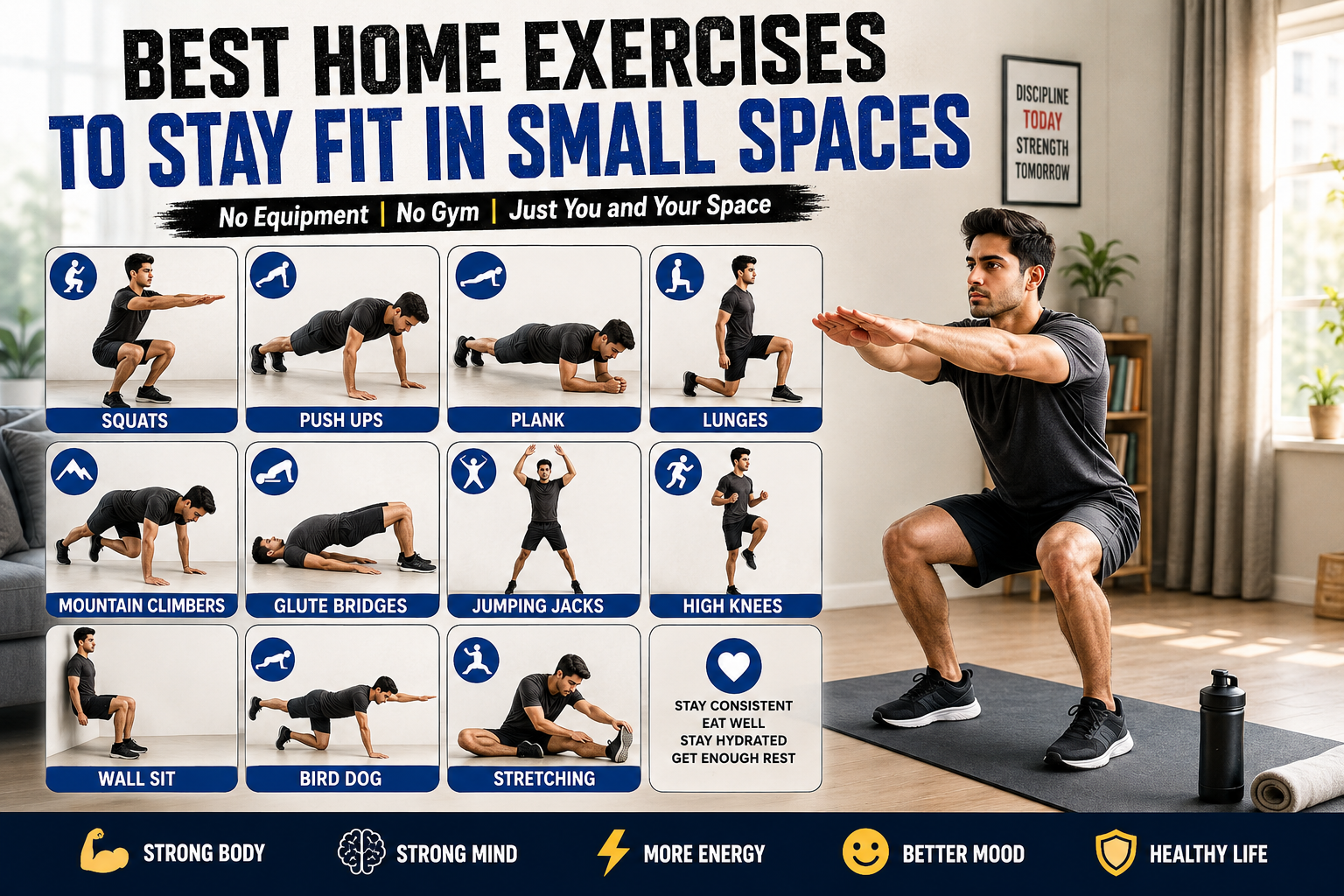
Bodyweight Squats
Squats quickly became one of my favorite exercises because they strengthen so many muscles at once.
They work the thighs, hips, glutes, calves, and even the core. Every time I perform squats correctly, I feel my entire lower body working together.
I stand with my feet shoulder width apart, keep my chest lifted, and slowly lower my hips as if sitting into a chair. Then I push through my heels to return to a standing position.
I usually perform three sets of fifteen repetitions. As I became stronger, I slowed down each repetition to increase the challenge without needing extra weight.
Push Ups
Push ups are one of the best upper body exercises that require absolutely no equipment.
When I first tried them, I could barely complete five proper repetitions. Instead of feeling discouraged, I started with knee push ups and gradually improved my strength.
Now regular push ups are part of nearly every workout.
This exercise strengthens the chest, shoulders, arms, and core at the same time. Keeping the body in a straight line throughout the movement is far more important than doing a large number of repetitions.
Even ten quality push ups are better than twenty rushed ones.
Plank Holds
I underestimated planks until I started doing them consistently.
At first they looked simple because there is almost no movement. After holding one for thirty seconds, I realized how challenging they really are.
Planks strengthen the entire core, including the abdominal muscles, lower back, and shoulders. They also improve posture, which is especially helpful if you spend long hours sitting at a desk.
I usually perform three rounds, holding each plank for thirty to sixty seconds while breathing steadily.
Glute Bridges
This exercise became one of my favorites after spending long hours working on my computer.
Sitting all day often makes the hips feel tight and weak. Glute bridges help activate the muscles that many of us neglect.
I lie on my back with my knees bent and feet flat on the floor. Then I press through my heels and lift my hips until my body forms a straight line from shoulders to knees.
I pause briefly at the top before lowering slowly.
After a few weeks of doing this exercise regularly, I noticed my lower back felt much more comfortable.
Lunges
Lunges challenge balance, coordination, and lower body strength.
Since my workout area is small, I usually perform stationary lunges instead of walking lunges.
I step one foot forward, lower both knees until they form roughly ninety degree angles, then push back to the starting position.
Each leg gets equal attention because balanced strength helps reduce the risk of injuries during everyday activities.
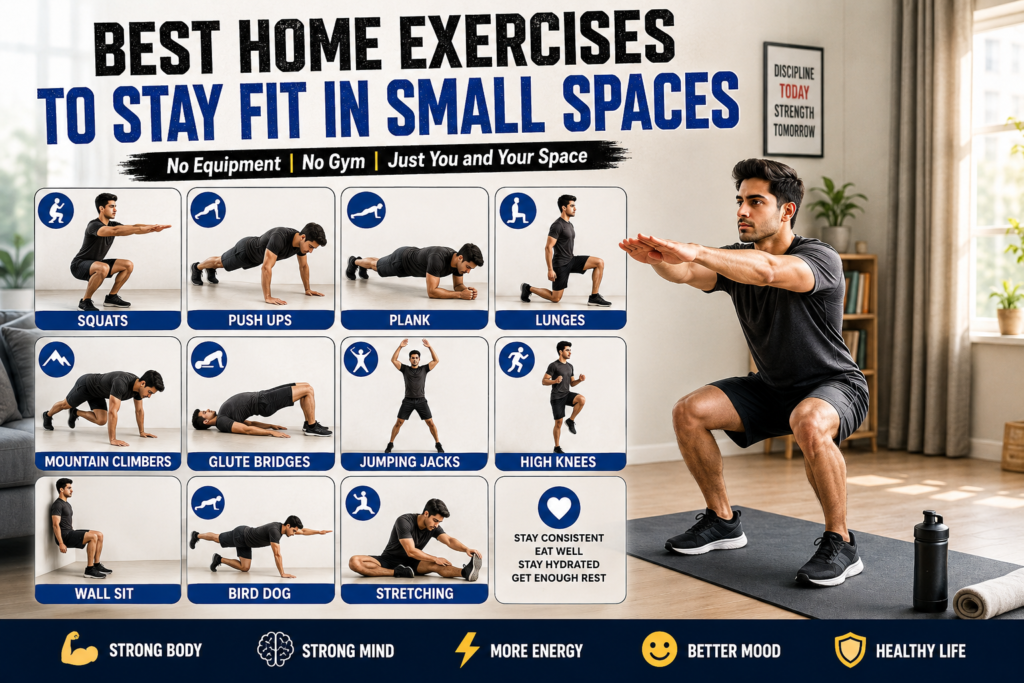
Mountain Climbers
Whenever I want to raise my heart rate without running, mountain climbers are my first choice.
They combine cardio with core training, making them extremely effective for short workouts.
Starting in a high plank position, I bring one knee toward my chest and quickly switch legs while maintaining a steady rhythm.
Even thirty seconds of mountain climbers leaves me breathing heavily.
They are excellent for improving endurance while taking up almost no space.
Jumping Jacks
Sometimes the simplest exercises remain the most effective.
Jumping jacks warm up the entire body while increasing blood circulation.
If I need a quick energy boost before starting strength exercises, I perform one or two minutes of jumping jacks.
On days when I want a quieter workout, especially early in the morning, I replace them with low impact step jacks to reduce noise.
Wall Sit
The wall sit taught me that staying still can be surprisingly difficult.
I lean against a wall and slide down until my knees form about a ninety degree angle.
Holding this position challenges the thighs and builds muscular endurance.
At first I struggled to hold it for twenty seconds. With practice, I eventually reached one full minute.
Small improvements like these kept me motivated because they clearly showed my progress.
High Knees
High knees are another excellent cardio exercise for limited spaces.
I simply jog in place while lifting my knees as high as possible.
The movement improves coordination, increases heart rate, and strengthens the legs.
I often include high knees during interval workouts by performing them for forty seconds followed by twenty seconds of rest.
Bird Dog Exercise
This exercise looks easy, but it requires concentration and control.
Starting on my hands and knees, I extend one arm and the opposite leg while keeping my back flat.
After holding the position briefly, I switch sides.
Bird dogs improve balance, core stability, and lower back strength.
Whenever my body feels stiff after sitting all day, this movement helps restore mobility.
Stretching Never Gets Skipped
I used to finish workouts and immediately move on with my day.
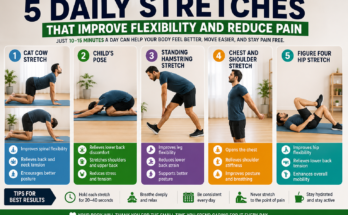
Eventually I realized that spending just five minutes stretching made a noticeable difference.
Now I stretch my hamstrings, quadriceps, calves, shoulders, chest, and hips after every session.
Stretching helps reduce muscle tightness and leaves me feeling refreshed rather than exhausted.
It has also improved my flexibility over time.
A Simple Full Body Routine
Whenever I do not want to think about planning a workout, I follow this simple routine.
Begin with two minutes of jumping jacks.
Continue with fifteen bodyweight squats.
Perform ten to fifteen push ups.
Hold a plank for forty five seconds.
Complete twelve lunges on each leg.
Do twenty glute bridges.
Perform thirty seconds of mountain climbers.
Finish with one minute of high knees.
End the workout with five minutes of stretching.
The entire routine takes about twenty five minutes and works almost every major muscle group.
Staying Motivated at Home
The hardest part of home workouts is usually staying consistent.
I found that creating a fixed schedule made everything easier. Instead of asking myself whether I felt motivated, I simply exercised at the same time every day.
Listening to energetic music also helped me stay focused.
Another habit that worked surprisingly well was tracking every completed workout on a calendar. Watching those check marks grow week after week motivated me to keep going.
I also learned not to expect perfection. Missing one workout is normal. The important thing is getting back to the routine the next day rather than quitting altogether.
Common Mistakes I Learned to Avoid
One mistake I made was trying to do advanced workouts too quickly. I believed harder always meant better, but that usually left me overly sore and unmotivated.
Another mistake was ignoring proper form. Performing fewer repetitions with good technique is much safer and produces better long term results.
I also underestimated the importance of rest. Muscles grow stronger during recovery, so taking rest days is just as valuable as training days.
Finally, I learned that nutrition plays a huge role in fitness. Even the best workout routine cannot completely make up for poor eating habits.
Final Thoughts
Looking back, I am glad I stopped using limited space as an excuse. My small workout corner has helped me become stronger, healthier, and more confident without requiring expensive equipment or a large home gym.
The biggest transformation did not happen because I found the perfect exercise. It happened because I stayed consistent with simple movements that fit my lifestyle. Squats, push ups, planks, lunges, glute bridges, mountain climbers, and stretching became part of my daily routine, and those small efforts added up over time.
If you have been waiting for the perfect moment to start exercising, remember that you do not need a huge room or fancy machines. Clear a small area, put on comfortable clothes, and begin with the exercises that match your current fitness level.
Your fitness journey can start in the smallest corner of your home, and with patience and consistency, that small space can lead to big results.